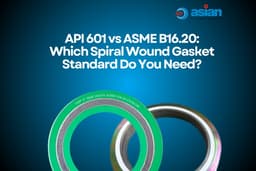


When selecting a gasket for a refinery, petrochemical plant, chemical processing facility, or other high-pressure industrial application, choosing the right specification is just as important as choosing the right gasket material. Two standards that often come up when selecting spiral wound gaskets are API 601 and ASME B16.20.
Although both are associated with metallic gaskets, they serve different purposes. Understanding the difference can help engineers, procurement teams, and maintenance professionals select the appropriate gasket specification for their piping and equipment requirements.
If you are currently comparing gasket specifications for a high-temperature or high-pressure application, this guide explains what API 601 and ASME B16.20 cover, where they are used, and how to determine which specification is relevant to your project.
What Is API 601?
API 601 is an American Petroleum Institute specification associated with metallic gaskets used in petroleum refining and related applications. It provides requirements for metallic gaskets used with flanges, valves, and other equipment in petroleum and petrochemical services.
The specification is particularly relevant where reliable sealing performance is required under demanding operating conditions.
API 601 focuses on requirements that help ensure gasket suitability for industrial applications, including factors such as:
- Gasket construction
- Materials
- Dimensions
- Manufacturing requirements
- Testing and inspection
- Marking and identification
- Quality requirements
For organizations operating in refining, petrochemical processing, and related industries, API specifications can form an important part of equipment and procurement requirements.
However, API 601 should not simply be treated as an alternative name for ASME B16.20. The two standards have different scopes and should be evaluated according to the specific equipment and piping requirements.
What Is ASME B16.20?
ASME B16.20 is a standard covering metallic gaskets for pipe flanges. It provides dimensional and manufacturing requirements for several types of metallic gaskets, including spiral wound gaskets.
The standard is commonly referenced alongside ASME B16.5 and ASME B16.47, which cover pipe flanges and flanged fittings.
For spiral wound gaskets, ASME B16.20 addresses important requirements such as:
- Gasket dimensions
- Construction
- Materials
- Inner and outer rings
- Winding requirements
- Identification
- Tolerances
- Pressure-temperature considerations
Because flange dimensions and gasket dimensions must work together correctly, ASME B16.20 is particularly important when selecting gaskets for standardized ASME flange systems.
API 601 vs ASME B16.20: What Is the Main Difference?
The easiest way to understand the difference is to consider their scope and application.
| Specification | Primary Focus | Typical Application |
|---|---|---|
| API 601 | Metallic gasket requirements for petroleum and related services | Refineries, petrochemical and process equipment |
| ASME B16.20 | Metallic gaskets for pipe flanges | ASME flange and piping systems |
ASME B16.20 is especially relevant when the gasket must match standardized ASME flange dimensions and requirements.
API 601, meanwhile, is relevant when a project, equipment specification, or purchaser specifically requires compliance with API requirements for metallic gaskets.
In some applications, both standards may be referenced in the purchasing or engineering documentation. Therefore, the correct approach is not to automatically choose one standard over the other.
When Does ASME B16.20 Apply to a Spiral Wound Gasket?
ASME B16.20 is commonly relevant when you are selecting a spiral wound gasket for a piping system using standardized ASME flanges.
For example, if your piping specification references ASME B16.5 flanges, the associated gasket requirements may reference ASME B16.20.
This is important because the gasket’s:
- Nominal pipe size
- Pressure class
- Outside diameter
- Inside diameter
- Winding construction
- Centering arrangement
- Inner and outer ring configuration
must be appropriate for the corresponding flange arrangement.
When ordering a gasket, simply providing the nominal size may not be sufficient. The pressure class, flange standard, gasket construction, filler material, winding material, and ring configuration may also need to be specified.
When Should You Consider API 601?
API 601 becomes particularly relevant when your project documentation or equipment specification calls for compliance with API requirements.
This can occur in petroleum refining, petrochemical, and related industrial applications where gasket performance and manufacturing requirements are governed by project specifications or industry standards.
Before placing an order, procurement teams should check whether the project specification explicitly requires API 601 compliance.
If API 601 is specified, the gasket manufacturer or supplier should be able to provide appropriate documentation demonstrating compliance with the required specification.
Does API 601 Replace ASME B16.20?
Not necessarily.
API 601 and ASME B16.20 should not be viewed as interchangeable standards. Their applicability depends on the equipment, piping system, project specification, and purchasing requirements.
For example, a project may require a gasket to conform to ASME B16.20 because the gasket is being installed between standardized ASME pipe flanges. A separate project specification may also identify API requirements for the application.
Therefore, engineers and procurement teams should review the complete project documentation rather than selecting a gasket based solely on one standard.
What Should You Check Before Ordering?
Before purchasing a spiral wound gasket, verify the following information:
1. Flange Standard
Identify the flange standard, such as ASME B16.5 or ASME B16.47. This helps determine the appropriate gasket dimensions.
2. Nominal Size
Confirm the pipe or flange nominal size. Gasket dimensions vary according to size and flange configuration.
3. Pressure Class
Check the flange pressure class, such as Class 150, 300, 600, 900, 1500, or 2500, where applicable.
4. Gasket Construction
Determine whether the application requires a standard spiral wound construction, inner ring, outer ring, or a specific winding arrangement.
5. Winding and Filler Materials
Select materials based on operating temperature, pressure, chemical compatibility, and process conditions.
6. Project Specification
Check whether the purchase specification requires compliance with API 601, ASME B16.20, or other applicable standards.
7. Documentation
For critical industrial applications, confirm the documentation required for inspection and traceability, such as material certificates, inspection reports, dimensional records, and compliance documentation.
API 601 or ASME B16.20: Which One Should You Choose?
There is no single specification that applies to every gasket application.
If your requirement involves a standardized ASME pipe flange system, ASME B16.20 is an important specification to consider for metallic gaskets, including spiral wound designs.
If your petroleum, refining, or petrochemical project specifically requires API 601, then the gasket should be supplied in accordance with the applicable API requirements.
The correct choice ultimately depends on the flange standard, equipment requirements, operating conditions, and project purchasing specification.
Final Checklist for Buyers
Before placing a gasket order, make sure you have confirmed:
- Flange standard
- Nominal pipe size
- Pressure class
- Gasket type
- Winding material
- Filler material
- Inner and outer ring requirements
- Operating temperature
- Operating pressure
- Chemical compatibility
- Required standard or specification
- Inspection and certification requirements
Choosing the correct specification at the purchasing stage can help reduce installation problems, compatibility issues, and unnecessary replacement costs.
For detailed information on construction, materials, applications, and selection considerations, explore the Spiral wound gasket range from Asian Sealing Product and match the gasket specification to your project’s technical requirements.
When API 601 and ASME B16.20 are both mentioned in a project, the safest approach is to review the applicable flange, equipment, and procurement specifications before finalizing the gasket. The correct standard should be determined by the actual application rather than by treating the two specifications as interchangeable.