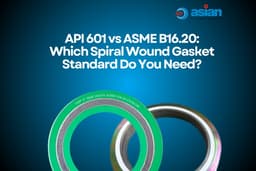



A spiral wound gasket is a semi-metallic sealing component manufactured by winding alternating layers of metal and filler material into a controlled spiral pattern. It is designed to provide reliable sealing between flanged connections and is widely used in oil and gas, petrochemical, chemical processing, power generation, refineries, marine and other industrial applications.
Selecting the right spiral wound gasket depends on more than just its size. Factors such as the flange standard, nominal pipe size, pressure class, flange facing, operating pressure, operating temperature, process media, winding material, filler material and ring configuration must be considered to achieve a reliable seal and prevent leakage.
This Spiral Wound Gasket Guide explains the different gasket types and configurations, construction, winding and filler materials, ASME B16.20 standards, dimensions and markings, pressure and temperature considerations, installation practices, applications and proper gasket selection.
What Is a Spiral Wound Gasket?
A spiral wound gasket is a semi-metallic gasket made by winding alternating layers of metallic strip and filler material into a spiral. It is used to seal flanged connections in applications involving pressure, temperature, chemical exposure and thermal cycling. The gasket configuration and materials should be selected according to the flange standard, pressure class, temperature, process media and applicable gasket standard such as ASME B16.20.
How Does a Spiral Wound Gasket Work?
The sealing mechanism depends on controlled compression of the gasket between two flange faces.
When the flange bolts are tightened, the gasket is subjected to compressive load. The filler material conforms to surface irregularities and helps establish the sealing interface, while the metallic winding provides structural strength and elastic recovery.
During operation, temperature changes, pressure fluctuations and mechanical movement can alter the load across the flange joint. The resilient winding helps the gasket accommodate some of these changes while maintaining contact with the flange surfaces.
The inner and centering rings, where specified, provide additional dimensional control and help protect the sealing element.
A leak-tight joint therefore depends on more than the gasket itself. Gasket selection, flange condition, bolt load, installation procedure and operating conditions all influence joint performance.
Spiral Wound Gasket Construction
A spiral wound gasket can consist of a sealing element alone or a sealing element combined with metallic rings.
1. Metallic Winding
The winding element is produced from a metallic strip formed into a spiral. Common materials include stainless steels and nickel-based alloys.
The winding material should be selected according to:
- Corrosion resistance
- Process media
- Operating temperature
- Mechanical requirements
- Thermal cycling
- Compatibility with the flange and process environment
2. Filler Material
The filler occupies the space between the metallic windings and contributes to the sealing function.
Common filler materials include:
- Flexible graphite
- PTFE
- Ceramic
- Mica or mica-based materials
- Other application-specific fillers
Filler selection is particularly important because different materials have significantly different chemical and temperature capabilities.
3. Inner Ring
An inner ring is a solid metallic ring located toward the gasket bore.
Depending on the application and applicable standard, an inner ring can:
- Support the winding at the inner diameter
- Reduce the possibility of inward buckling
- Protect the sealing element from process flow
- Help control compression
- Provide additional stability in demanding service
ASME B16.20 contains specific requirements concerning the use and dimensions of inner rings for applicable spiral-wound gasket configurations. Therefore, inner-ring selection should be based on the actual flange, size, pressure class and gasket specification rather than a blanket rule that every high-pressure gasket must have one.
4. Centering Ring
The outer or centering ring helps position the gasket concentrically within the flange bolt circle.
It can also provide:
- Radial support
- Improved handling
- Controlled positioning during installation
- Protection of the sealing element
- Identification through standardized marking and color coding
Spiral Wound Gasket Types and Configurations
Spiral wound gasket configurations are commonly identified by the construction of their sealing element, inner ring and centering ring.
| Configuration | Construction | Typical consideration |
|---|---|---|
| Style R | Basic spiral-wound sealing element without integral centering/inner rings | Used where the flange arrangement or gasket seating configuration provides the necessary positioning |
| Style IR / inner-ring configuration | Spiral-wound sealing element with an inner ring | Used where additional inner support/protection is required |
| Style CG | Spiral-wound sealing element with a centering ring | Common for applications requiring controlled centering and external support |
| Style CGI | Spiral-wound sealing element with both | Used where both external positioning and inner support are required |
The exact configuration should be specified against the applicable gasket and flange standard.
Important: Spiral Wound Gaskets Are Not the Same as RTJ Gaskets
A common specification error is treating the “R” designation of a spiral wound gasket as a ring-joint gasket designation.
They are different gasket technologies.
Ring Type Joint (RTJ) gaskets are solid metallic rings with oval or octagonal cross-sections designed to fit RTJ grooves. API 6A, for example, contains requirements for ring gaskets used with wellhead and related equipment.
A spiral wound gasket is a semi-metallic wound gasket designed for the applicable flange configuration.
Therefore, do not select a spiral wound gasket merely because a flange is high pressure. First identify the actual flange facing and applicable standard.
Spiral Wound Gasket Filler Materials
The filler material has a major influence on chemical compatibility, temperature capability and sealing behavior.
| Filler | General Characteristics | Typical Applications |
|---|---|---|
| Flexible Graphite | Excellent resilience and high-temperature capability in suitable environments | Steam, hydrocarbons, refining, petrochemical and general industrial service |
| PTFE | Excellent chemical resistance across many aggressive media | Chemical processing and applications requiring high chemical resistance |
| Mica-based filler | Suitable for selected elevated-temperature applications | High-temperature services where the specified filler chemistry is appropriate |
| Ceramic-based filler | Used for selected high-temperature applications | Specialized high-temperature service |
Flexible Graphite
Flexible graphite is widely used because of its combination of resilience, conformability and temperature capability.
However, graphite should not automatically be treated as suitable for every chemical service. Oxidizing conditions, chemical compatibility, contamination requirements and operating temperature must be considered.
PTFE
PTFE offers broad chemical resistance and is useful for many aggressive chemical applications. Its practical temperature capability is lower than that of graphite, so the complete operating envelope must be checked before specification.
Mica and Ceramic Fillers
Mica- and ceramic-based fillers can be considered for selected high-temperature applications. Their suitability depends on the exact product construction and service conditions.
Do not choose a filler solely from a maximum temperature number. Process chemistry, pressure, oxidation environment and manufacturer-specific data must also be considered.
Spiral Wound Gasket Winding Materials
The metallic winding should provide adequate mechanical and corrosion resistance for the intended application.
| Winding Material | General Characteristics | Typical Selection Consideration |
|---|---|---|
| SS304 | General-purpose austenitic stainless stee | Mild to moderate corrosive environments |
| SS304L | Low-carbon version of SS304 | Applications requiring low-carbon stainless steel |
| SS316 | Improved resistance compared with SS304 in many environments | Chemical and industrial applications |
| SS316L | Low-carbon SS316 | Common choice where corrosion resistance and low-carbon construction are required |
| SS321 | Stabilized stainless stee | Elevated-temperature applications |
| SS347 | Stabilized stainless steel | Elevated-temperature applications |
| Inconel 600/625 | Nickel-based alloys for demanding temperature/corrosion environments | Specialized high-temperature or corrosive service |
| Monel 400 | Nickel-copper alloy | Selected marine and chemical environments |
| Hastelloy alloys | High corrosion resistance in specific aggressive environments | Specialized chemical service |
There is no universal “best” winding material.
For example, SS316L is not automatically the correct choice for every industrial application, and Inconel should not simply be treated as an upgraded version of stainless steel. Material selection should be based on the actual process conditions and applicable material compatibility requirements.
Spiral Wound Gasket Material Selection
A practical selection process should consider the following parameters:
| Selection Factor | What to Check |
|---|---|
| Flange | ASME B16.5, B16.47, EN, JIS |
| Size | NPS / DN |
| Operating pressure | Class / PN |
| Flange facing | RF / FF / other |
| Winding material | SS304 / SS316L / alloy |
| Filler | Graphite / PTFE / other |
| Temperature | Operating + design |
| Media | Chemical/process fluid |
| Standard | ASME B16.20 or applicable standard |
The correct gasket is therefore a system selection, not simply a product selection.
Standards for Spiral Wound Gaskets
Standards are critical because gasket dimensions and markings must correspond to the flange system for which the gasket is intended.
ASME B16.20
ASME B16.20 is the ASME standard covering metallic gaskets for pipe flanges, including applicable spiral-wound gasket dimensions, materials, tolerances and markings. It should be used together with the applicable flange standard when selecting a gasket.
ASME B16.5
ASME B16.5 covers pipe flanges and flanged fittings for specified NPS sizes and pressure classes. When specifying a spiral wound gasket for an ASME B16.5 flange, the gasket dimensions must correspond to the flange size, pressure class and facing.
ASME B16.47
ASME B16.47 covers large-diameter steel flanges and includes Series A and Series B configurations. Large-diameter spiral wound gasket dimensions therefore need to be matched to the applicable flange series rather than relying on nominal pipe size alone.
EN 1514-2
For PN-designated European flange systems, EN 1514-2 specifies dimensions and marking requirements for spiral wound gaskets used with steel flanges. The standard is associated with EN 1092-1 flange systems and covers PN10, PN16, PN25, PN40, PN63, PN100 and PN160 applications up to DN1000 within its stated scope.
JIS B 2404
JIS B 2404:2018 specifies types and dimensions of gaskets used with pipe flanges covered by relevant JIS flange standards, including JIS B 2220, B 2239, B 2240 and B 2241. It does not itself specify gasket materials or criteria for use.
API 6A
API Specification 6A applies to wellhead and Christmas tree equipment and includes requirements for ring gaskets and other sealing components used within its scope. It should not be described as the general dimensional standard for spiral wound gaskets.
Standards Selection Summary
| Application / Flange System | Relevant Standard |
|---|---|
| ASME pipe flanges | ASME B16.20 with applicable ASME B16.5 requirements |
| Large-diameter ASME flanges | ASME B16.20 with applicable ASME B16.47 Series A/B requirements |
| PN-designated European flanges | EN 1514-2 with applicable EN flange standard |
| JIS flange systems | JIS B 2404 with applicable JIS flange standard |
| API 6A wellhead equipment | API Specification 6A requirements applicable to the equipment/sealing component |
Always identify the flange standard before specifying the gasket standard.
ASME B16.20 Spiral Wound Gasket Color Coding
ASME B16.20 includes standardized material identification through color coding and abbreviations.
For spiral-wound gasket color coding , the winding material is identified by a continuous color around the outer edge of the centering ring, while filler identification uses intermittent stripes. ASME B16.20 specifies four filler stripes at approximately 90-degree intervals for NPS 1½ and larger, with smaller gaskets having at least two stripes.
Selected examples include:
| Metallic Winding | ASME B16.20 Color Code |
|---|---|
| Carbon Steel | Silver |
| Type 304 SS | Yellow |
| Type 316L SS | Green |
| Type 317L SS | Maroon |
| Type 321 SS | Turquoise |
| Type 347 SS | Blue |
| Monel 400 | Orange |
| Nickel 200 | Red |
| Titanium Grade 2/7 | Purple |
| Inconel 600 | Gold |
| Inconel 625 | Gold |
Selected filler markings include:
| Filler | Color stripe |
|---|---|
| Flexible Graphite | Gray |
| PTFE | White |
| Ceramic | Light Green |
| Vermiculite / specified mica materials | Refer to applicable standard marking |
The current ASME table contains a considerably larger material list than the simplified charts commonly published online. Therefore, do not rely on a short color chart as a substitute for the current ASME B16.20 marking requirements.
For critical service, verify the gasket marking, purchase specification, material documentation and applicable certificate rather than identifying the material from color alone.
Spiral Wound Gasket Dimensions
Gasket dimensions depend on the flange standard, nominal size, pressure class, facing and gasket configuration.
Important dimensions may include:
- Inside diameter of the sealing element
- Outside diameter of the sealing element
- Centering ring outside diameter
- Inner ring inside diameter
- Gasket thickness
- Ring dimensions
- Bolt-circle relationship
- Required radial clearances
ASME B16.20 provides dimensional requirements and tables for spiral wound gaskets used with the applicable flange standards. The standard also includes requirements and recommendations concerning flange bore and inner-ring use.
Information Required for Ordering
Do not order a spiral wound gasket based only on “6-inch Class 300.”
A better specification includes:
NPS + flange standard + pressure class + flange facing + gasket style + winding material + filler + ring requirements
For example:
NPS 6, ASME B16.5, Class 300, raised face, CGI configuration, SS316L winding, flexible graphite filler.
The exact specification should then be checked against the applicable standard and project requirements.
Spiral Wound Gasket Pressure and Temperature Selection
A spiral wound gasket does not have one universal pressure rating or temperature rating.
The permissible operating envelope depends on the:
- Flange pressure class
- Flange material
- Operating temperature
- Gasket construction
- Winding material
- Filler
- Process media
- Joint assembly
- Applicable design code
The pressure class printed on the flange does not mean the gasket itself can be assigned a universal pressure number independent of temperature.
ASME flange pressure-temperature ratings must be considered together with the applicable flange material and design conditions.
Therefore, avoid statements such as:
“Class 600 spiral wound gasket = X bar at every temperature.”
That is technically misleading.
For engineering applications, use the applicable flange pressure-temperature table and gasket manufacturer’s technical data.
Spiral Wound Gasket Installation Best Practices
Even a correctly specified gasket can leak if the flange joint is assembled incorrectly.
1. Inspect the Flange
Check both flange faces for:
- Radial scratches
- Corrosion
- Pitting
- Distortion
- Residual gasket material
- Surface damage
- Misalignment
2. Verify the Gasket
Before installation, confirm:
- Gasket size
- Pressure class
- Gasket configuration
- Winding material
- Filler material
- Ring configuration
- Markings
- Certificate/documentation where required
3. Position the Gasket
Ensure the gasket is correctly centered within the flange arrangement. A centering ring assists positioning where provided.
4. Check Bolting
Inspect studs, bolts, nuts and threads. Use a suitable lubricant compatible with the bolting material, process and application.
5. Tighten in a Controlled Pattern
Use an appropriate cross/star tightening sequence and progressively increase bolt load in multiple passes.
6. Use a Defined Assembly Procedure
Do not rely on a generic torque number.
ASME PCC-1 provides guidance for pressure-boundary bolted flange joint assembly, including gasket selection, target gasket assembly stress, bolting, lubrication and tightening methods.
The required torque depends on factors such as:
- Bolt size
- Bolt material
- Lubrication
- Friction coefficient
- Target bolt load
- Gasket construction
- Flange design
- Required gasket seating stress
Therefore, a single universal torque value for all spiral wound gaskets is not technically appropriate.
Common Spiral Wound Gasket Failure Causes
While spiral wound gaskets are renowned for their high resilience and ability to withstand severe pressure fluctuations, joint integrity depends on proper selection, handling, and installation. In many industrial processing units, recurring flange leaks are mistakenly attributed to component failure rather than systemic assembly issues. If you are evaluating different semi-metallic sealing options, understanding the key operational differences in our complete guide to spiral wound gaskets can help prevent premature joint failure. Below are the most frequent causes of spiral wound gasket breakdown and their direct impact on flange performance:
| Failure Cause | Typical Effect |
|---|---|
| Incorrect gasket dimensions | Poor seating or flow interference |
| Wrong filler material | Chemical degradation or loss of sealing |
| Incorrect winding material | Corrosion or temperature-related degradation |
| Insufficient bolt load | Corrosion or temperature-related degradation |
| Excessive bolt load | Gasket damage or flange distortion |
| Uneven bolt loading | Localized leakage |
| Damaged flange face | Leakage path across the sealing surface |
| Incorrect gasket configuration | Poor positioning or inadequate support |
| Thermal cycling | Loss of joint load and gasket stress |
| Reused gasket | Reduced ability to conform and seal |
| Incorrect lubrication | Bolt-load variation despite identical torque |
| Flange misalignment | Uneven compression |
Recurring leakage should be treated as a joint-system problem, not automatically as a gasket-quality problem.
How to Choose the Right Spiral Wound Gasket ?
Use this six-step process before Choosing the Right Spiral Wound Gasket or placing an order.
Step 1: Identify the Flange
Determine:
- Standard
- NPS/DN
- Pressure class/PN
- Facing
- Material
Step 2: Identify the Service
Document:
- Process media
- Concentration
- Normal temperature
- Maximum temperature
- Normal pressure
- Design pressure
- Vacuum conditions if applicable
Step 3: Select the Filler
Choose graphite, PTFE, ceramic, mica-based or another suitable filler based on chemical and thermal compatibility.
Step 4: Select the Winding
Choose stainless steel or an appropriate alloy based on corrosion, temperature and mechanical requirements.
Step 5: Determine the Gasket Configuration
Determine whether the application requires a basic sealing element, centering ring, inner ring or combined configuration according to the applicable standard and service.
Step 6: Verify Dimensions
Confirm the gasket against the actual flange standard and applicable dimensional table.
Spiral Wound Gasket Applications
Spiral wound gaskets are used across industries where reliable flange sealing is required.
Oil and Gas
- Process piping
- Refineries
- Gas processing
- Compressor systems
- Pipeline equipment
- Flanged process connections
Petrochemical and Chemical Processing
- Reactors
- Heat exchangers
- Distillation equipment
- Process piping
- Pumps and valves
- Chemical handling systems
Power Generation
- Steam systems
- Heat exchangers
- Boiler-related piping
- Turbine systems
- High-temperature flange connections
Marine and Offshore
- Process piping
- Utility systems
- Pumps and valves
- Offshore equipment
- Marine process systems
Water and Industrial Processing
- Water treatment
- Desalination
- Industrial process systems
- Large-diameter piping
- Pumping systems
Spiral Wound Gasket Specification Checklist
Before sending a purchase enquiry, provide as much of the following information as possible:
| Specification | Required Information |
|---|---|
| Gasket type | R, CG, CGI or applicable configuration |
| Size | NPS/DN |
| Flange standard | ASME B16.5, B16.47, EN, JIS, etc. |
| Pressure class | Class 150/300/600/etc. or PN |
| Facing | RF, FF, tongue-and-groove, etc. |
| Winding | SS304, SS316L, Inconel, Monel, etc. |
| Filler | Required/not required according to specification |
| Centering ring | Required/not required |
| Temperature | Operating/design temperature |
| Pressure | Operating/design pressure |
| Media | Process fluid |
| Quantity | Required quantity |
| Drawing | If custom/non-standard |
The more complete the specification, the easier it is to verify gasket suitability before manufacture.
Why Proper Spiral Wound Gasket Selection Matters ?
A spiral wound gasket is a relatively small component within a piping system, but its performance can have a significant effect on plant reliability.
Correct selection can help:
- Reduce flange leakage
- Minimize unplanned maintenance
- Improve joint reliability
- Reduce gasket-related downtime
- Support safe process operation
- Improve repeatability during maintenance
- Reduce the risk of selecting incompatible materials
However, gasket performance is never determined by the gasket alone. Flange condition, bolting, installation procedure, operating conditions and joint design are equally important.
Why Choose Asian Sealing for Spiral Wound Gaskets?
Asian Sealing Products supplies spiral wound gaskets for industrial applications with configurations and material combinations selected according to flange standards and operating requirements.
- Manufacturing: Standard and application-specific spiral wound gasket configurations, including inner and outer ring designs.
- Materials: SS304, SS316L, nickel-based alloys and fillers such as flexible graphite, PTFE, ceramic and other application-specific materials.
- Standards: ASME B16.20, ASME B16.5, ASME B16.47, API 605, MSS SP44, EN 1514-2, BS and JIS standards.
- Pressure Classes: Available for ASME Classes 150, 300, 600, 900, 1500 and 2500, subject to applicable size and flange requirements.
- Size Range: Gaskets are available for standard and large-diameter flange applications, with dimension charts covering ASME B16.5 and B16.47 applications.
- Customization: Custom configurations can be evaluated using customer drawings, flange dimensions, material specifications and operating conditions.
- Quality & Testing: Technical documentation includes ASME-based construction and performance test-load references, dimensional charts and allowable leakage-rate data.
For a quotation or application-specific selection, provide the size, pressure class, flange standard, facing, temperature, pressure and process media.
Conclusion
Choosing the right spiral wound gasket requires more than matching a gasket diameter to a pipe size. The flange standard, pressure class, flange facing, operating temperature, pressure, process media, winding material, filler, gasket configuration and installation procedure must all work together.
For ASME applications, start with ASME B16.20 for the metallic gasket requirements and then identify the applicable flange standard, such as ASME B16.5 or ASME B16.47. For European and Japanese flange systems, use the applicable EN or JIS gasket and flange standards rather than transferring ASME dimensions directly.
For critical applications, do not select a gasket from a generic temperature chart or pressure table alone. Confirm the complete operating envelope, material compatibility, dimensional requirements and assembly procedure.
Asian Sealing Products supplies spiral wound gasket solutions for industrial applications, including standard and application-specific requirements. If you have a gasket drawing, flange standard, NPS/DN, pressure class, operating temperature, pressure and process media, share those details with the technical team to identify the appropriate gasket construction and material combination.
Need help selecting the right spiral wound gasket? Contact Asian Sealing Products for application-specific technical support and a quotation.
Frequently Asked Questions
Spiral wound gasket dimensions depend on the flange standard, nominal size, pressure class, facing and gasket configuration there is no single “one size fits all” dimension table. ASME B16.20 provides the governing dimensional requirements for gaskets used with ASME-standard flanges, including inside diameter, outside diameter, centering ring diameter, inner ring diameter, thickness, and required radial clearances.
Spiral wound gaskets are used wherever a flanged connection needs a reliable seal under pressure, temperature, or thermal cycling — most commonly in oil and gas, petrochemical and chemical processing, power generation, and marine/offshore piping systems.
Style CG (centering ring only) is used where external positioning support is sufficient for the flange arrangement. Style CGI (centering ring plus inner ring) is used where the application also requires internal support — for example, higher pressure classes or PTFE-filled gaskets where an inner ring helps prevent buckling. The applicable standard and flange specification determine which is required.
No. The “R” designation used for certain spiral wound gasket configurations should not be confused with an RTJ or ring-joint gasket. RTJ gaskets are solid metallic rings designed for RTJ flange grooves.
There is no universal best filler. Flexible graphite is widely used for many hydrocarbon, steam and industrial applications, while PTFE is often selected where broad chemical resistance is required. The correct choice depends on the actual process media, temperature and pressure.
Not automatically. SS316L provides improved resistance in many chloride-containing and corrosive environments, but SS304 or other materials may be appropriate for less aggressive service. Material selection should be based on the actual process conditions.
For ASME flange systems, ASME B16.20 is the principal metallic gasket standard. The applicable flange standard, such as ASME B16.5 or B16.47, must also be identified because gasket dimensions depend on the flange system.
Yes. ASME B16.20 includes requirements for gasket materials, dimensions, tolerances and markings, including color identification for applicable spiral-wound gasket materials.
No universal rule should be applied. Inner-ring requirements depend on the applicable standard, gasket size, pressure class, filler, flange arrangement and service. ASME B16.20 contains specific requirements concerning inner rings for applicable spiral-wound gasket constructions.
A spiral wound gasket should generally be replaced after a flange joint has been opened. The compressed sealing element has already undergone deformation and should not be relied upon for a second installation.
Common causes include inadequate or uneven bolt load, incorrect gasket dimensions, incompatible filler or winding materials, damaged flange faces, flange misalignment, thermal cycling and incorrect installation procedures.
A spiral wound gasket does not have one universal pressure or temperature rating. Its usable operating envelope depends on the flange pressure class, flange material, gasket construction, winding material, filler, and process media — all evaluated together against the applicable flange pressure-temperature table.
ASME B16.20 covers metallic gasket requirements such as dimensions, materials, tolerances and markings. ASME B16.5 covers pipe flanges and flanged fittings. They work together when specifying compatible gaskets for applicable ASME flange systems.
EN 1514-2 specifies dimensions and markings of spiral wound gaskets for use with steel flanges in PN-designated European flange systems within its stated scope.
Yes, custom requirements can be evaluated based on customer drawings, flange dimensions, material specifications and operating conditions. For non-standard applications, provide the complete technical specification so the gasket configuration can be reviewed before manufacture.
Correct installation requires inspecting both flange faces, verifying the gasket’s size and material against the specification, centering it properly, and tightening bolts in a controlled cross/star pattern across multiple passes per ASME PCC-1 guidance — a single generic torque value is not appropriate for every joint.